
Investors today have two main approaches for analyzing stocks: stock screening and AI-powered analysis. Stock screening uses fixed filters like P/E ratios or dividend yields to create a shortlist of stocks. In contrast, AI-powered tools analyze massive datasets, including financial metrics, news sentiment, and earnings transcripts, to predict stock performance with greater accuracy.
Key takeaways:
- Stock screening is rule-based and relies on structured data like price or financial ratios.
- AI-powered analysis uses machine learning to process both structured and unstructured data, identifying patterns and trends.
- AI tools are dynamic, recalibrating in real-time, while stock screening requires manual updates.
- AI systems have shown 60% accuracy in price predictions, compared to 53–57% for human analysts.
Quick Overview:
- Stock screening is best for simple, metric-driven strategies and budget-conscious investors.
- AI-powered analysis excels in handling complex data and predicting future trends, making it ideal for active traders or professionals.
The best results often come from combining both methods: use AI for broad market analysis, then apply manual research for deeper insights.
3 Prompting Techniques That Turn AI Into an Investing Analyst (Masterclass Replay)
What is Stock Screening?
Stock screening is a systematic way to sift through thousands of stocks and identify potential investment candidates. Think of it like a search engine: you input specific criteria, and the tool returns companies that match. With over 7,000 stocks listed on U.S. exchanges, manually analyzing each one would be an overwhelming task.
A stock screener typically has three core components: a database packed with financial data, user-defined filters (like a P/E ratio under 20 or a dividend yield above 3%), and a screening engine that applies these filters using Boolean logic (AND, OR, NOT). This process generates a list of companies that meet the criteria. However, as AAII emphasizes:
"The passing company list of a stock screener IS NOT a buy list; it is a set of companies with the same base set of criteria that still require additional research".
This distinction is vital. While screeners excel at crunching numbers, they don’t account for qualitative factors like leadership quality or pending lawsuits, which require deeper investigation.
How Stock Screening Works
The process starts with broad filters like sector, industry, or market cap. From there, investors fine-tune the results using specific metrics - valuation ratios, growth indicators, or profitability measures. Stock screeners rely on historical, quantitative data, applying consistent rules to identify companies that meet every condition set by the user.
Benefits of Stock Screening
The biggest perk? Efficiency. Tasks that could take hours manually are done in seconds with a screener. No wonder 54% of retail investors use these tools. By focusing on quantitative data, screeners help minimize emotional bias, offering a disciplined and systematic way to evaluate stocks. This approach not only ensures consistency but can also uncover opportunities that might go unnoticed otherwise.
Another advantage is accessibility. Basic screeners, like those on Yahoo Finance, Finviz, and Google Finance, are free, making them perfect for beginners. Premium platforms, on the other hand, offer advanced features like real-time data, backtesting, custom scripting, and data exports. This means investors of all experience levels can use stock screening without needing a big budget.
Next, we’ll dive into how AI-powered tools take these basics to the next level, offering even more insights for smarter decision-making.
What is AI-Powered Analysis?
AI-powered analysis takes a giant leap beyond traditional methods by using machine learning to uncover hidden market signals. Unlike static filters that match stocks to pre-set criteria, AI systems analyze both structured data (like price, volume, and financial ratios) and unstructured data (such as news articles, social media sentiment, earnings call transcripts, and SEC filings). This approach creates a much richer and more detailed understanding of market dynamics.
The key difference? AI adapts. Traditional screeners stick to fixed rules, but AI platforms continuously evolve as they process new data. Using both supervised and unsupervised learning, these systems can detect subtle patterns in price movements, sector trends, and even broader economic shifts. Natural Language Processing (NLP) plays a crucial role here, analyzing text from diverse sources to assign sentiment scores. This blend of qualitative insights and quantitative models gives AI a unique edge.
How AI-Powered Analysis Works
The magic of AI-powered analysis lies in its dynamic and adaptive process. It integrates real-time data streams - like price feeds, financial statements, alternative data (e.g., satellite imagery or credit card spending), and even textual data from news and social platforms. Machine learning models then identify patterns across this multidimensional data, uncovering relationships in record time.
Here’s a breakdown of how it works:
- Machine Learning Engine: Updates predictive models using techniques like neural networks and gradient boosting.
- NLP Module: Extracts sentiment and thematic signals from text-based data.
- Data Pipeline: Normalizes and streams real-time data feeds for seamless analysis.
Many systems also use online learning, which allows them to recalibrate immediately as new information comes in. This ensures strategies stay relevant, even when market conditions change.
Benefits of AI-Powered Analysis
The advantages of AI are both measurable and impactful. For instance, AI systems achieve up to 60% accuracy in price predictions, outperforming the 53–57% range typical of human analysts. Additionally, AI-based forecasting improves precision by 15% and reduces errors by 20%. A standout example: an AI-powered equity fund delivered 10.1% returns in the first half of 2023, doubling the 5% return of traditional funds during the same period.
Speed and scale are other standout benefits. Consider the fact that an average S&P 500 company generates over 1,000 pages of regulatory filings each year. AI can process and summarize this information in seconds. Retail investors using AI tools also report a 32% higher satisfaction rate, with many outperforming average index returns.
As highlighted by Sean Cao, Wei Jiang, Junbo L. Wang, and Baozhong Yang in their NBER working paper:
"Combining AI's computational power and the human art of understanding soft information produces the highest potential in generating accurate forecasts."
Platforms like Calypso exemplify this approach, offering tools like AI Opinions, Transcript Search, and Earnings Previews to help investors make quicker, smarter decisions. The rise of Explainable AI (XAI) further enhances trust by showing users exactly which factors influenced a recommendation, meeting both investor expectations and regulatory standards.
These advancements set the stage for a deeper comparison between traditional rule-based filtering and machine learning-driven predictions.
Rule-Based Filtering vs. Machine Learning Prediction

Stock Screening vs AI-Powered Analysis: Key Differences Comparison
The key difference between traditional stock screening and AI-driven analysis lies in how they process data and make decisions. Stock screening relies on fixed, user-defined rules - like filtering for stocks with a P/E ratio below 15 or a dividend yield above 3%. These are straightforward "if-then" conditions that remain unchanged unless manually adjusted. In contrast, AI-powered analysis uses machine learning algorithms that uncover intricate, non-linear patterns across vast datasets, all without needing explicit programming.
As Phil Davis from the CFA Institute puts it:
"The term 'machine learning' describes the process by which algorithms uncover relationships without explicit programming instructions."
This fundamental distinction shapes how these methods handle data and adapt to changing conditions. Traditional screeners focus on structured data - metrics like price, volume, and financial ratios - producing binary outputs. Meanwhile, AI models integrate both structured and unstructured data, such as news sentiment and social media trends, to deliver probability scores, predictive rankings, and trend forecasts.
Another major difference lies in adaptability. Rule-based filters remain static until you manually tweak them to reflect changing market conditions. AI models, however, operate with a self-correcting loop, recalibrating automatically as market environments shift. This feature becomes especially crucial during periods of market volatility or unexpected events, where AI models equipped with online learning can adjust their parameters in real time.
Comparison Table: Capabilities
| Capability | Stock Screening (Rule-Based) | AI-Powered Analysis (Machine Learning) |
|---|---|---|
| Logic Basis | Static, user-defined thresholds | Dynamic, pattern-based algorithms |
| Data Types | Structured (Price, Fundamentals) | Structured + Unstructured (Sentiment, News) |
| Data Handling Volume | Limited to spreadsheet-level metrics | Processes millions of data points in seconds |
| Pattern Recognition | Linear; identifies simple crossovers/ratios | Non-linear; detects complex, hidden correlations |
| Predictive Modeling | Descriptive (what fits the rule now) | Predictive (probability of future performance) |
| Real-Time Adaptability | Low; requires manual rule updates | High; continuous learning and real-time recalibration |
| Risk Assessment | Static metrics (e.g., Beta, Volatility) | Scenario simulations and stress testing |
| Scalability | Limited by human processing capacity | Handles high-dimensional, voluminous data |
The complexity of logic also sets these approaches apart. Traditional screens rely on simple conditions, while machine learning employs advanced techniques like Random Forests, Recurrent Neural Networks (RNN), and Natural Language Processing (NLP). These tools enable AI to combine qualitative insights - such as news sentiment - with quantitative data, assigning polarity scores to textual information and bridging the gap between qualitative and quantitative analysis.
sbb-itb-02b1c6d
Limitations and When to Use Each
Limitations of Stock Screening
Traditional stock screening has a tough time keeping up when market conditions shift. Fixed filters like P/E ratios or moving average crossovers are rigid and can falter when historical trends break or new market dynamics emerge. Plus, the sheer volume of data can lead to errors in spreadsheets or flawed model outputs.
Human analysis isn't without its flaws either. Cognitive and emotional biases - overconfidence, anchoring to consensus views, fear, greed, and herd mentality - can lead to inconsistent decisions. Predictive accuracy for human analysts typically hovers around 53–57%. Traditional screeners also have a blind spot: they rely on structured metrics and can't factor in unstructured data like news sentiment, social media buzz, or insights from earnings call transcripts.
Limitations of AI-Powered Analysis
AI-powered analysis, while advanced, comes with its own set of hurdles. It relies heavily on high-quality data, and poor inputs can lead to "black box" scenarios where predictions lack transparency. Overfitting is another pitfall - models might excel on historical data but stumble when faced with drastic changes, like the market upheavals during the COVID-19 pandemic.
There’s also a learning curve for those new to AI tools, and costs - whether from setup or subscription fees - can be prohibitive for smaller investors. AI models, while powerful, may struggle during black swan events, when unprecedented conditions make historical patterns unreliable.
Choosing the Right Approach
Deciding between traditional stock screening and AI-powered analysis boils down to your investment style and objectives. If you're a long-term value investor focused on steady financial ratios and qualitative factors - like brand reputation and management quality - traditional stock screening might be your best bet. It's transparent, gives you control, and works well on a tighter budget that might not accommodate costly AI platforms.
On the other hand, AI-powered analysis is ideal for high-frequency strategies, tracking thousands of securities at once, or integrating sentiment from news and social media. AI thrives in handling complex scenarios with large, diverse datasets.
A smart strategy often blends both methods. Use AI to sift through vast amounts of data and create a focused watchlist or spot emerging trends. Then, follow up with manual due diligence - like reviewing earnings transcripts and evaluating management performance - before making a move.
As Sean Cao, Wei Jiang, Junbo L. Wang, and Baozhong Yang explain:
"Combining AI's computational power and the human art of understanding soft information produces the highest potential in generating accurate forecasts".
Calypso: AI-Powered Equity Analysis
Key Features of Calypso
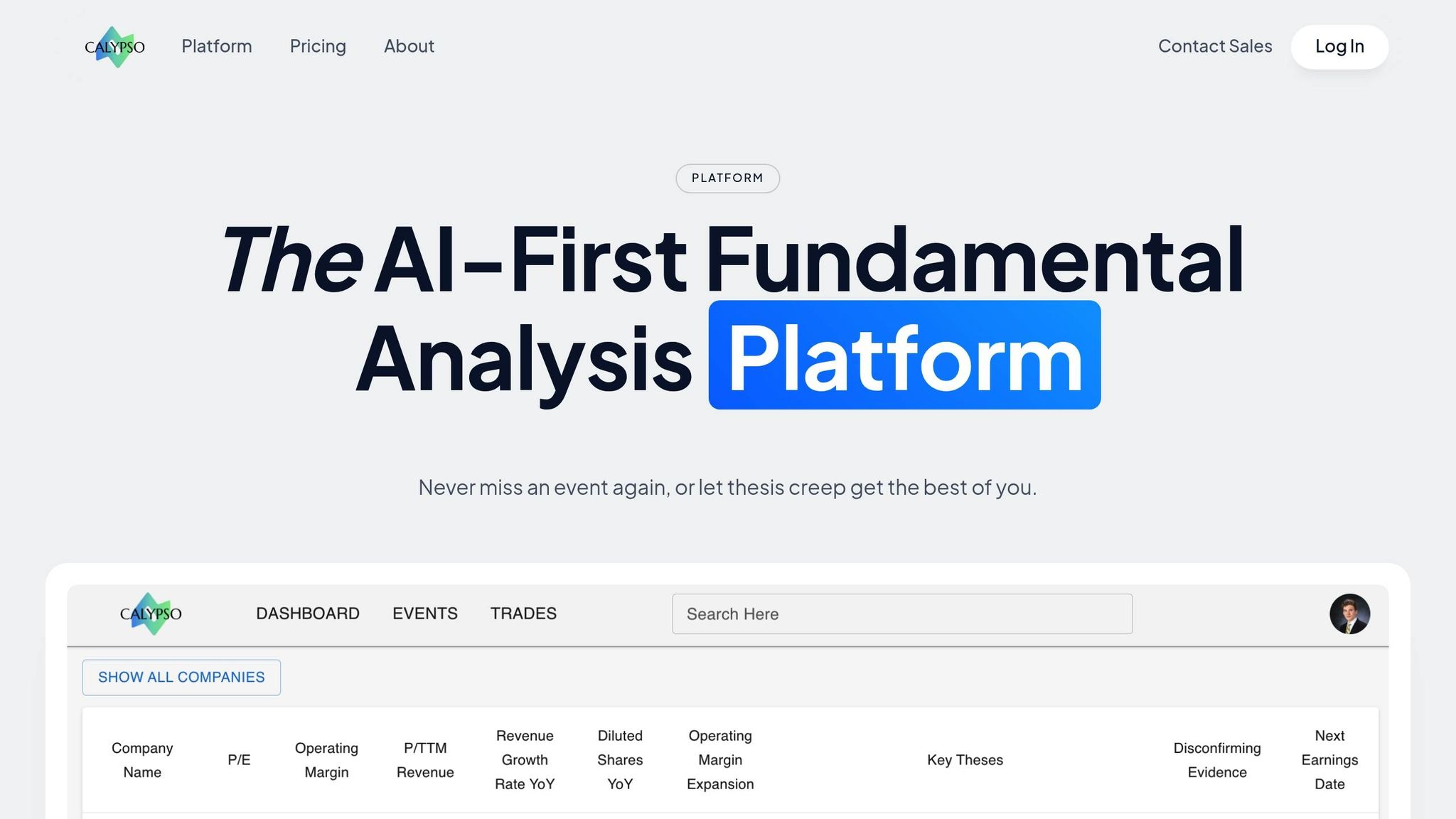
Calypso zeroes in on the narratives that influence stock prices. Instead of relying solely on static financial ratios, it combines AI with earnings transcripts, financial data, and news headlines to uncover why stocks are moving - not just what the numbers reveal.
The AI Opinions tool simplifies complex analyst debates, making it easier to understand investment narratives. It also helps you stick to your original investment thesis, reducing the risk of "thesis creep" - that tendency to justify holding onto a position even when the initial reasoning no longer holds up. With Transcript Search, you can instantly find mentions of specific terms like "inflation" or "data centers" across all public transcripts. The results are displayed in a single view, saving hours of manual research.
AI Chats takes things a step further, using a GPT-4 model trained with insights from top hedge fund case studies. You can ask direct questions about competitor mentions or product impacts, bypassing lengthy webcasts to get straight to the answers you need. The platform also offers AI-generated earnings previews and updates, ensuring you're always up-to-date on critical calls and meetings for covered companies.
Calypso boasts that it allows analysts to ramp up on new coverage 90% faster compared to traditional methods. Its AI models are fine-tuned using expertise and case studies from leading hedge funds, giving it an edge over generic AI tools. These features demonstrate how AI can blend qualitative insights with quantitative analysis for a more comprehensive view.
Why Calypso Works for Professionals
Calypso is designed to meet the demands of professionals like hedge fund analysts, equity researchers, investment bankers, and active investors. It tackles a major challenge of traditional stock screening: data overload. By synthesizing qualitative insights and hard data, Calypso fills the gaps that static screeners often overlook. It pulls key bull and bear debates, street-level theses, and management quotes from unstructured data - details that standard filters miss entirely.
For those managing multiple positions, the Journal feature is a game-changer. It tracks investment theses and aligns outcomes with the original rationale, helping users maintain discipline and avoid emotional decision-making.
The platform's pricing reflects its professional focus. The Basic plan is $10/month, offering 20 AI Opinions and 20 AI Chats daily. The Professional tier, at $399/month, includes 400 daily interactions, live support, and faster feature updates.
AI systems have demonstrated up to 60% accuracy in price predictions, outperforming the 53–57% accuracy range typical of human analysts. As Sean Cao, Wei Jiang, Junbo Wang, and Baozhong Yang observed:
"An AI analyst trained to digest corporate disclosures, industry trends, and macroeconomic indicators surpasses most analysts in stock return predictions".
Calypso's real strength lies in its ability to process the "soft information" that traditional tools can't handle. These qualitative nuances are often the key drivers behind both short-term price movements and long-term investment success.
Combining Stock Screening and AI-Powered Analysis
Blending stock screening with AI-powered analysis can yield powerful results. Traditional screeners are great at applying strict filters based on financial metrics, but they often miss the nuances found in unstructured data like earnings call transcripts, news sentiment, or alternative indicators. AI steps in here, processing these complex data points with speed and precision. Together, these methods combine AI's computational efficiency with human judgment, minimizing emotional biases and addressing potential blind spots in algorithms.
Start with AI to sift through thousands of stocks, creating a focused watchlist based on patterns and predictive signals. From there, use fundamental analysis to evaluate qualitative factors like management effectiveness, competitive strengths, and industry-specific risks. This layered approach has been supported by recent studies.
One example of this hybrid strategy is MarketSenseAI, introduced in January 2024 by researchers George Fatouros, Konstantinos Metaxas, John Soldatos, and Dimosthenis Kyriazis. Using GPT-4 for stock selection, the framework analyzed market trends, news, and fundamentals during a 15-month test on S&P 100 stocks, ending in late 2023. The AI-driven system generated investment signals that delivered an excess alpha of 10% to 30% and a cumulative return of up to 72%, all while maintaining a risk profile similar to the overall market.
For the best results, set clear boundaries. Manually define limits for drawdowns, sector exposure, and position sizes. Let AI handle real-time monitoring, alerting you to spikes in volatility or rising correlations.
Traders integrating AI into their workflows have reported reducing research time by up to 90%. Use AI to uncover statistical patterns and trends, but always validate these signals with your expertise and risk management framework. This balance between machine precision and human insight consistently delivers strong outcomes across varying market conditions.
Conclusion
Traditional stock screening and AI-driven analysis serve different purposes in the investment world. Rule-based screeners are great for filtering stocks based on specific metrics, like P/E ratios or dividend yields, making them a solid choice for straightforward, value-focused strategies. On the other hand, AI-powered platforms take things further by analyzing unstructured data - like news sentiment, earnings call transcripts, and even social media trends - while uncovering complex patterns that traditional methods might overlook. Where traditional screeners tell you what fits your criteria now, AI tools predict future performance using historical data and real-time signals.
The numbers back this up: AI-powered funds have been shown to deliver returns that are double those of traditional methods, along with better prediction accuracy.
This advantage translates directly into practical tools for investors. Take Calypso, for example - a platform designed for today’s fast-paced markets. It processes thousands of data points from global markets in seconds, a task that would take hours if done manually. With features like AI Opinions, Transcript Search, and Earnings Previews, Calypso provides both speed and transparency, making it a valuable resource for professionals in hedge funds, equity research, and investment banking. By combining traditional screening with AI-driven insights, it supports smarter, more efficient decision-making at every stage of the investment process.
The real power lies in blending both approaches. Use AI to sift through massive datasets and uncover hidden opportunities, then apply human judgment to assess qualitative factors like leadership quality or competitive positioning. As Sean Cao from the Robert H. Smith School of Business explains:
"Combining AI's computational power and the human art of understanding soft information produces the highest potential in generating accurate forecasts".
FAQs
How does AI-powered analysis make stock predictions more accurate?
AI-driven analysis enhances the precision of stock predictions by quickly processing massive amounts of data and spotting complex patterns that traditional methods might overlook. Unlike conventional techniques, which often depend on human judgment and historical data, AI leverages machine learning and deep learning to analyze a wide range of sources in real time. These include market news, social media sentiment, corporate filings, and economic indicators.
By constantly learning from fresh data, AI minimizes biases and adjusts to shifting market dynamics, making its predictions more dependable. Its knack for identifying subtle connections within complex datasets helps investors gain sharper insights, particularly in fast-paced or data-heavy markets. This capability positions AI as a valuable tool for making more precise and well-informed investment choices.
What are the challenges of using AI for stock analysis?
AI-powered stock analysis brings plenty of benefits to the table, but it’s not without its challenges. One major hurdle is its reliance on historical data. While past trends can offer insights, they don’t always predict future market conditions - especially when markets behave unpredictably or during periods of high volatility. Another sticking point? These systems need vast amounts of high-quality data to function effectively. When that data is incomplete or inconsistent, the accuracy of predictions can take a hit.
There’s also the matter of interpreting qualitative factors. AI can crunch numbers and analyze patterns, but it often struggles with elements like market sentiment, intangible assets, or the complexities of macroeconomic trends - areas where human expertise plays a critical role. On top of that, AI models require constant updates and maintenance to keep up with evolving market dynamics. Without regular fine-tuning, their predictions can quickly become less reliable.
The takeaway? While AI offers powerful tools for stock analysis, it works best when paired with human judgment. This combination helps ensure investment decisions are both informed and balanced.
Can traditional stock screening and AI-powered analysis work together to improve investment decisions?
Combining traditional stock screening with AI-powered analysis can offer a more nuanced approach to investment decisions. Stock screening, which relies on predefined metrics like financial ratios or technical indicators, provides a clear and focused way to filter stocks. However, its capabilities can sometimes feel limited when dealing with more complex or less obvious market factors.
This is where AI-powered analysis steps in. By utilizing tools like machine learning, natural language processing, and real-time data analysis, AI can uncover patterns, predict trends, and identify opportunities that might escape traditional methods. For example, AI can evaluate news sentiment, track macroeconomic trends, or even detect subtle shifts in market behavior that a basic screen might overlook.
When these two methods are combined, investors gain a powerful framework. AI can handle the heavy lifting of analyzing large, intricate datasets, while traditional screening tools allow for targeted filtering based on specific criteria. Together, they offer a balance of precision and breadth, which is particularly useful in fast-moving markets where quick, informed decisions are essential.
