
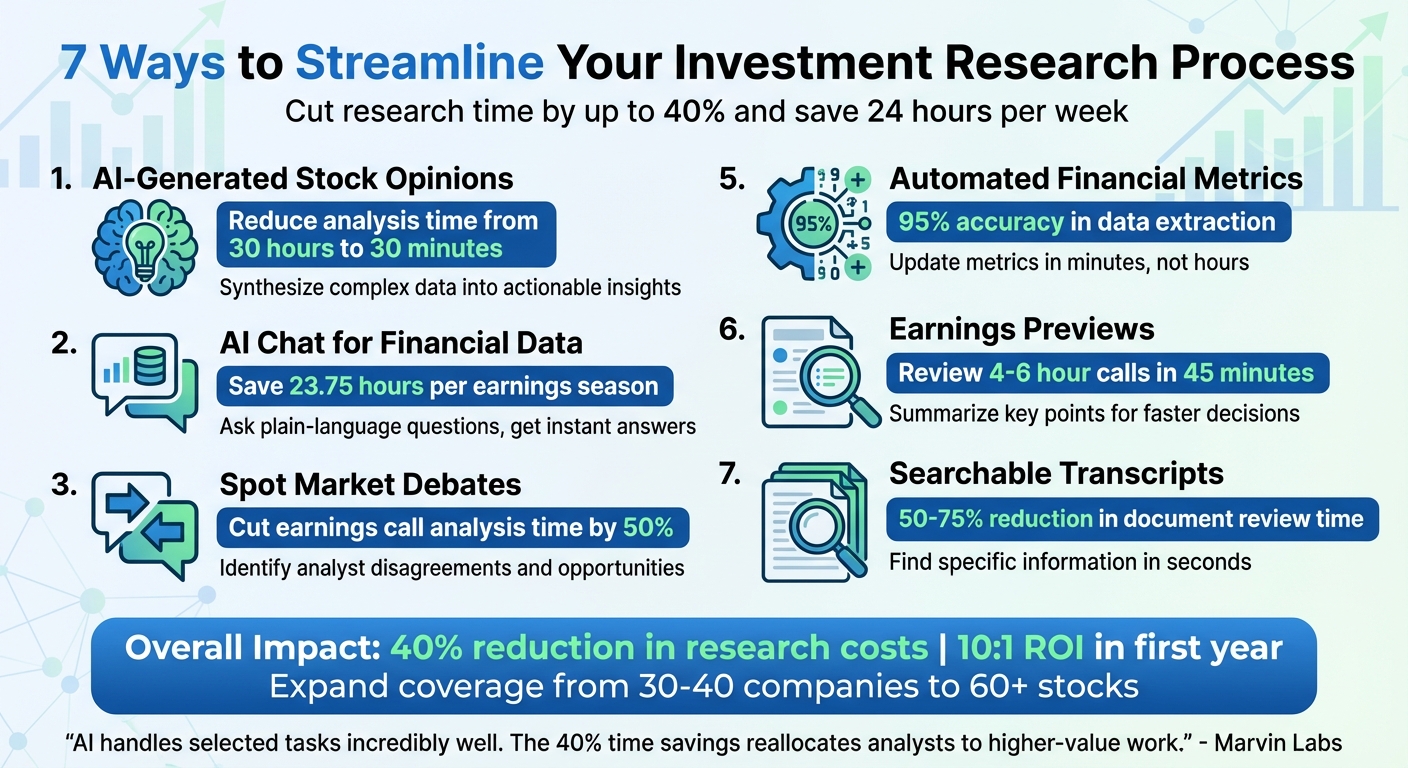
Investing takes time, but AI tools can make your research faster and more efficient. Here’s how you can save time, reduce costs, and improve accuracy with these seven methods:
- AI-Generated Stock Opinions: Quickly analyze stocks by summarizing complex data into actionable insights.
- AI Chat for Financial Data: Ask plain-language questions and get instant answers from filings and reports.
- Spot Market Debates: Identify disagreements in analyst opinions to find potential investment opportunities.
- Custom Dashboards: Centralize portfolio data for real-time tracking and analysis.
- Automated Financial Metrics: Extract and update key metrics from filings in minutes, not hours.
- Earnings Previews: Summarize key points from earnings reports quickly for faster decision-making.
- Searchable Transcripts: Use AI to find specific information in earnings calls in seconds.
These strategies can cut your research time by up to 40% and help you cover more companies without sacrificing depth. Whether you're managing a small portfolio or working in a large firm, AI tools can simplify your workflow and improve decision-making.
7 AI-Powered Methods to Streamline Investment Research Process
AI Co-Pilots in Investment Research: A New Era for Data and Alpha Generation | Cutting Edge Series
sbb-itb-02b1c6d
1. Use AI Opinions for Fast Stock Analysis
AI-generated opinions take the heavy lifting out of stock analysis by synthesizing financial data, earnings transcripts, and SEC filings into concise, actionable insights. Instead of spending hours poring over lengthy documents, analysts can now access detailed evaluations in mere minutes, allowing them to focus on making strategic decisions.
Time Efficiency
In 2024, investment firm VanEck demonstrated how AI tools could dramatically cut research time. By using AI to process earnings transcripts and research notes, they reduced analyst preparation time from 30 hours to just 30 minutes for specific tasks. These tools can process new filings almost instantly, ensuring research stays current and relevant.
Accuracy of Insights
AI also excels at ensuring critical details don’t get overlooked. A Stanford study led by Professor Ed deHaan in January 2026 showcased how an AI analyst, built using 170 variables from public data, outperformed 93% of mutual fund managers over a 30-year span - delivering results that were 600% better.
"AI beat 93% of managers over a 30-year period by an average of 600%." – Ed deHaan, Professor of Accounting, Stanford Graduate School of Business
This level of precision ensures that analysts can trust AI to uncover hidden insights buried in complex data.
Customizability
Modern AI platforms go beyond just speed and accuracy - they’re highly adaptable. These tools can be tailored to fit various investment strategies, whether it’s fundamental analysis, technical charting, options trading, or sector-specific research. Analysts can even create custom queries to monitor specific themes like supply chain vulnerabilities or regulatory changes. This flexibility allows them to expand their coverage from 30–40 companies to over 60 stocks, all while maintaining a deep level of analysis.
2. Query Financial Data with AI Chats
AI chat interfaces are changing the way analysts interact with financial data by turning complex queries into straightforward, conversational questions. This user-friendly approach allows analysts to ask plain-language questions and instantly retrieve insights from filings, transcripts, and financial statements. Let’s break down how this technology improves efficiency, accuracy, and workflow automation.
Time Efficiency
Analyzing financial data has traditionally been a time-consuming process. For example, evaluating merger synergies could take half a day, requiring analysts to comb through years of earnings calls. Now, AI-driven chat tools can complete these tasks in seconds, saving an estimated 23.75 hours per earnings season. Thanks to natural language processing, these tools can scan thousands of documents - both structured and unstructured - almost instantly. This includes sources like SEC filings, news reports, and earnings call transcripts, which are often overlooked by traditional models.
Accuracy of Insights
Speed is important, but accuracy is critical. General-purpose AI models often falter with complex financial data, with error rates reaching up to 41% for finance-related queries when using unverified systems. However, integrating verified data layers and retrieval-augmented generation can slash this error rate to under 1%. Features like linking answers to original sources, complete with page numbers, further enhance reliability.
Specialized models trained on financial terminology also shine here. For instance, general models may misunderstand terms like "basis points" or "maintained guidance", but fine-tuned systems can boost accuracy from 73% to 96% when handling such jargon. A notable example is Morgan Stanley’s AI assistant, launched in 2024, which allowed 98% of its Financial Advisor teams to efficiently search and summarize insights from over 70,000 proprietary research reports.
Automation Capabilities
AI chat tools go beyond answering questions - they automate entire workflows. Tools like "Deep Research Agents" continuously monitor platforms like SEC EDGAR filings and investor relations pages, alerting analysts as soon as new documents are available. These agents can compare current performance against past results and management guidance, updating research notes in real time.
The impact on efficiency is substantial. For example, AI automation can reduce a 90-minute document review to just 6 minutes, saving analysts around 24 hours per week, which translates to a 40% reduction in workload.
"AI reduces time spent on data collection and validation. It can handle large datasets in real time and uncover patterns that are not obvious to human financial analysts".
Customizability
AI chat tools are highly adaptable to different investment strategies and research needs. Analysts can configure these tools to track specific KPIs, set custom alerts for material changes, and even tailor output formats - whether it’s a quick summary for a morning meeting or a detailed client memo.
Unlike traditional database filters, these tools support natural language queries, such as "Find tech stocks with insider buying" or "Show companies with growing free cash flow trading below book value". They can also run thousands of "what-if" simulations in seconds, helping analysts explore various market scenarios - tasks that would take days to complete manually. By automating repetitive tasks, AI allows analysts to focus on strategy and decision-making, treating the technology as an assistant rather than a replacement.
3. Review Key Debates to Spot Market Disagreements
Market disagreements often reveal some of the most promising investment opportunities. When analysts have conflicting opinions about a stock’s future, it signals uncertainty - and where there’s uncertainty, there’s often mispricing. The trick is identifying these debates quickly, without wading through endless reports. By combining automated insights with targeted data queries, you can refine your investment research and uncover these hidden opportunities.
Time Efficiency
Sifting through analyst reports and competitive outlooks manually can eat up hours. Thankfully, AI-powered tools have made this process far quicker. For example, Smart Summaries use AI to pull out key SWOT analyses and make Q&A sections from earnings calls searchable, cutting research time dramatically. These Q&A sections are especially valuable because analysts often dig into areas that press releases gloss over. Instead of reading through entire transcripts, you can now find critical insights in seconds.
To put the need for efficiency into perspective, as of January 31, 2026, market dispersion stands at 54 points - a clear indicator of the growing gap between sector leaders and laggards. With increasing complexity in filings and reports, automated tools for synthesizing debates are no longer optional; they’re essential.
Accuracy of Insights
Speed isn’t everything - precision is just as critical. AI tools powered by Natural Language Processing (NLP) can analyze sentiment shifts in management’s tone, often signaling slowing performance before it shows up in the numbers. These shifts are quantified into sentiment scores (ranging from 0 to 100), allowing you to track changes over time or compare them across companies.
"Sentiment analysis... identifies deceleration signals before they appear in financial metrics." - Marvin Labs
One red flag to watch for: executives who enthusiastically discuss a business segment one quarter but avoid questions about it the next. AI tools can catch these "dropped details", like missing KPIs or vague commentary, which might indicate reduced transparency. Comparing analyst projections across competitors can also reveal accounting adjustments or quirks that distort reported results.
Automation Capabilities
Modern AI platforms are constantly monitoring market debates, making it easier to stay ahead. For instance, AI tools can cut the time needed to analyze earnings calls by 50%, freeing you up to focus on interpreting the data rather than gathering it. They also use keyword tracking to ensure no critical aspect of a market debate is overlooked.
The impact of automation is hard to ignore. AlphaSense, for example, is used by 88% of the S&P 500 and 90% of leading asset management firms for market intelligence. These tools allow analysts to expand their coverage from 30–40 companies to over 60, without sacrificing depth. This means you can monitor debates across entire sectors instead of focusing on just a few key players.
Customizability
AI tools also offer a high degree of flexibility, letting you tailor them to your specific needs. You can set up custom dashboards to centralize alerts for particular themes, like liquidations or arbitrage opportunities. Track sentiment scores for the metrics that matter most to your investment thesis, whether it’s margins, customer acquisition costs, or inventory turnover.
This approach also helps sharpen your contrarian instincts. By envisioning potential failures and using AI to highlight opposing views, you can build stronger conviction in positions that go against the grain. The goal isn’t just to gather opinions but to identify which debates actually impact stock prices - and which are just noise.
4. Create Custom Dashboards for Portfolio Tracking
Custom dashboards take portfolio tracking to the next level by centralizing all your data into a single, real-time platform. When you're managing multiple portfolios, juggling outdated spreadsheets and scattered information can feel overwhelming. Dashboards simplify this chaos, delivering up-to-date insights and cutting down on time-consuming manual tasks.
Time Efficiency
Did you know manual portfolio customization used to eat up 40% of analysts' time? AI-powered tools are changing the game. With the right setup, you can transform raw data into actionable insights four times faster. These tools pull structured data straight from filings, ensuring your models are always current and reliable.
"The initial time investment in building automation pays dividends through consistent, accurate, and timely portfolio insights." – Mito Team
Start small. Focus on essential metrics like P/E ratios, ROIC, or debt-to-equity before diving into more complex scoring models. To make your dashboards more intuitive, use visual aids like conditional formatting - green for low debt levels, red for high payout ratios. It makes scanning your data a breeze.
Automation Capabilities
Modern dashboards bring automation into the mix, keeping your data updated in real time without the need for manual refreshes. For example, when you adjust a single ticker or date range, linked parameters automatically update all related widgets. Some platforms even allow AI agents to interact with widget metadata, answering specific questions by analyzing underlying datasets. When extracting data from financial tables, specialized AI models can now hit over 95% accuracy.
This level of automation ensures your dashboard evolves with your strategy, adapting to your specific needs.
Customizability
Custom dashboards are all about flexibility. Drag-and-drop canvases let you organize widgets however you like, creating visual hierarchies that fit your workflow. You can switch between interactive tables and dynamic charts with just one click, while maintaining control over styling and data management.
For those who rely on spreadsheets, dashboards allow you to apply custom weightings to metrics, like giving ROIC more importance than earnings growth. You can even build scoring systems that align with your investment philosophy. As your dashboards grow, staying organized is key - use nested folders (e.g., "Research" > "Sectors" > "Technology") to keep everything tidy. Some platforms also let you toggle an "AI flag", which controls whether specific widgets are accessible for AI analysis, safeguarding sensitive or internal data.
5. Extract Financial Metrics Automatically
Custom dashboards are great for centralizing data, but the real game-changer is automating the extraction of financial metrics. This approach keeps data accurate and up to date, eliminating the inefficiencies of manual entry. AI-powered tools can drastically cut the time it takes to process earnings data. For instance, importing and cleaning data from SEC filings, which used to take 5–6 hours, can now be done in under 20 minutes. In 2024, an investment management firm adopted an AI-driven NLP core to analyze earnings call transcripts and research notes, slashing preparation time for extracting financial metrics from 30 hours to just 30 minutes.
Accuracy of Insights
Saving time is great, but accuracy is just as important - if not more. AI models designed for financial data extraction now achieve over 95% accuracy when handling financial tables. Unlike human analysts, who might miss details hidden in lengthy documents or obscure footnotes, AI systems review every single detail consistently. They also provide auditable hyperlinks that link each extracted figure directly back to the source document, making verification quick and easy.
Automation Capabilities
Modern AI tools can handle both structured data, like XBRL files, and unstructured content, such as PDFs, investor presentations, and earnings call transcripts. These tools allow for one-click updates, automatically refreshing figures in Excel as new filings are released. They can extract full income statements, balance sheets, cash flow statements, and even company-specific KPIs - like segment-level revenue or subscriber counts - straight from filings. Companies using these AI-driven research tools report up to a 40% reduction in research costs.
Customizability
For analysts who need tailored calculations, some platforms offer Python or JavaScript integration directly within Excel add-ins. These tools can generate custom Power Query M code or VBA scripts to connect with APIs, even for users without programming experience. Analysts can set historical ranges for metrics like revenue growth or margins, enabling the system to flag outliers before they impact models.
6. Prepare for Earnings Reports with Previews
Earnings season can feel like a whirlwind, especially when you're trying to keep up with dozens of companies. AI-powered earnings previews make it easier by delivering concise summaries of key points, questions, and topics - often within hours of a call being published. These tools build on earlier AI efficiencies, simplifying the preparation process for critical data.
Time Efficiency
Analyzing earnings reports manually can take up to 15 hours each week. With AI-driven previews, that workload shrinks dramatically. Tasks like reviewing a 4–6 hour earnings call can now be completed in just 45 minutes. That’s a huge time saver, allowing you to focus on higher-level decision-making.
Accuracy of Insights
Speed doesn’t have to come at the cost of accuracy. Today’s AI models pull insights from trusted sources like SEC filings and earnings transcripts, avoiding reliance on general web data. To ensure reliability, advanced systems use a three-agent verification process, cross-checking responses to reduce misinformation. Plus, Natural Language Processing (NLP) can pick up on subtle cues - like shifts in management tone or hedging language - that might go unnoticed in a manual review. These accurate, automated insights blend seamlessly into your workflow.
Automation Capabilities
AI tools excel at handling large-scale data. They can analyze multiple transcripts at once, offering a consolidated view of industry trends and peer performance. Continuous monitoring ensures that new filings are processed automatically, keeping your research up to date. Additionally, these tools can populate Excel models with numeric data directly from filings, cutting down on manual data entry and reducing errors. With these capabilities, AI-powered previews set the stage for faster and more efficient earnings call analysis.
7. Search Earnings Call Transcripts Quickly
Going through a single earnings call transcript typically takes about 25 minutes. During earnings season, analysts might need to comb through dozens of these documents. AI-powered search tools make this process much faster, pinpointing specific information in just seconds. By adding transcript search to your AI-driven research toolkit, you can streamline your workflow significantly.
Time Efficiency
AI platforms can cut document review time by 50% to 75%. For example, analysts have reported saving 25% of their time during earnings season by automating transcript searches. These tools don't just locate keywords; they use smart synonyms to find related terms even when companies phrase things differently. This means you can quickly get answers to key questions, like next-quarter guidance, without manually searching through pages of text.
Accuracy of Insights
AI search tools go beyond basic keyword matching - they understand context. They can even analyze sentiment and tone at the sentence level, helping you detect subtle shifts in management confidence or signs of hesitation that might point to deeper issues. Unlike human analysts who can become fatigued, AI consistently reviews every detail. These tools can also group commentary into themes, such as inflation, supply chain issues, or AI adoption, allowing you to zero in on the topics most relevant to your investment strategy.
Automation Capabilities
Building on earlier automation solutions, advanced platforms can process transcripts in mere minutes and generate summaries within 30 to 60 minutes for over 14,000 companies worldwide. You can even set up automated alerts to notify you as soon as a new transcript is available. Many tools let you click directly on summarized insights to jump to the exact section in the full transcript, saving even more time.
Customizability
Modern tools come with customizable search options. You can filter results by ticker symbols, sectors, date ranges, or custom watchlists to focus on what matters most to you. Some platforms let you compare current transcripts with past ones to identify inconsistencies or trends. Features like "clip and convert" allow you to extract financial tables directly from PDFs into editable Excel files, eliminating the need for manual data entry and reducing the risk of errors. These customization options ensure the tool fits seamlessly into your workflow.
Feature Comparison Table
Calypso provides two subscription options tailored to different levels of investment research. The Basic plan, priced at $10 per month, is ideal for individual investors, while the Professional plan, at $399 per month, is designed for professional teams conducting in-depth research. The standout difference between the two is the daily query allowance: Basic users are limited to 20 AI Opinions and 20 AI Chats per day, sufficient for focused research on a few stocks. Professional users, on the other hand, enjoy a substantial boost with 400 of each per day, making it suitable for analyzing dozens of companies in a single session. Both plans include access to financial data, news, and market debates, but the Professional plan also offers live support and faster processing for feature requests - especially handy during busy times like earnings season.
| Feature | Basic Plan | Professional Plan |
|---|---|---|
| Monthly Price | $10 | $399 |
| AI Opinions | 20 per day | 400 per day |
| AI Chats | 20 per day | 400 per day |
| Financials, News & Debates | Included | Included |
| Support | Standard | Live support |
| Feature Requests | Standard | Priority/Faster processing |
| Free Trial | 14 days | Not specified |
| Best For | Individual Investors | Hedge Funds, Equity Research, Investment Banking |
The table above highlights the differences between the two plans. For individual investors, the 14-day free trial of the Basic plan is a great way to test the platform's capabilities before committing. However, if your daily research involves more than one or two stocks, you might quickly reach the 20-query limit and find the Professional plan more suitable. For institutional teams requiring even more capacity, Calypso offers custom enterprise plans with higher query limits available upon request.
Calypso's AI tools enable users to speed up their research process by up to 90%, making the Professional plan a compelling choice for teams managing a broad portfolio or conducting detailed analyses.
Conclusion
Investment research no longer requires grueling 60-hour workweeks. The seven strategies discussed - ranging from AI-driven stock analysis to searchable earnings transcripts - can cut your workload by up to 40%, potentially freeing up around 24 hours each week for more strategic tasks.
By adopting these methods, analysts have significantly reduced manual work while expanding their coverage without compromising on depth. Companies using these strategies report a 40% drop in research costs and a return on investment exceeding 10:1 within the first year. This creates a clear advantage, especially in fast-moving markets.
"AI handles some selected tasks incredibly well. The 40% time savings reallocates analysts to higher-value work, it doesn't eliminate the role." - Marvin Labs
AI-enhanced workflows not only save time but also improve the quality of investment decisions. Analysts can now detect subtle changes in risk language, monitor a broader spectrum of securities, and reduce emotional bias in decision-making. The result? A more efficient and insightful approach to research.
FAQs
How do AI tools make investment research more accurate?
AI tools bring a new level of precision to investment research by processing massive datasets - like financial reports, earnings calls, and filings - at speeds that manual methods simply can't match. They dig deep to reveal patterns, trends, and anomalies that might slip past even the most seasoned analysts, offering a clearer picture of a company's performance.
By taking over repetitive tasks such as data collection and analysis, AI minimizes human error and ensures consistent results. This frees up analysts to concentrate on strategic decisions, delivering timely and accurate insights that inspire greater confidence in investment evaluations.
What are the advantages of using custom dashboards to track your portfolio?
Custom dashboards bring several advantages to portfolio tracking, making investment management more efficient and effective. They offer a centralized view of all your assets - whether it’s brokerage accounts, retirement funds, or crypto holdings. This consolidated perspective makes it easier to track your entire portfolio in one place. By doing so, you can quickly spot issues like imbalances, overlapping investments, or excessive fees, allowing you to make smarter moves such as rebalancing or implementing tax-loss harvesting strategies.
Another major perk is the time saved through automated updates and visualizations. Forget the hassle of manual data entry or juggling spreadsheets. Dashboards can be tailored to show real-time market data, performance metrics, and reports that align with your investment approach. This automation ensures you’re always working with accurate, up-to-date information, boosting efficiency while reducing errors.
Custom dashboards also improve decision-making by zeroing in on the metrics that matter most to your financial goals. Acting as a dynamic control center, they help you keep tabs on performance, assess risks, and respond swiftly to market changes. In short, they simplify portfolio management and equip you to make better-informed investment decisions.
How can AI chat tools improve financial data analysis?
AI chat tools are making waves in financial data analysis by automating tedious tasks like extracting, summarizing, and interpreting massive amounts of unstructured data. Think about company filings or earnings reports - these tools can sift through them quickly and efficiently. Even better, analysts can use plain language to query intricate datasets, cutting down on time and effort while making insights more accessible, no advanced coding skills required.
Another big advantage? These tools boost both accuracy and efficiency. By reducing the risk of human error and processing thousands of documents at once, they uncover patterns, highlight risks, and spot opportunities that might slip through the cracks during manual reviews. This not only saves time but also empowers analysts to make better-informed investment decisions.
That said, while AI tools are incredibly helpful, double-checking their findings is crucial. Ensuring data reliability and addressing potential inaccuracies remains a key part of the process.
