
The financial research landscape in 2026 has evolved, with professionals increasingly relying on a mix of tools. Bloomberg Terminal remains the top choice for real-time market data and trading, costing $24,000–$30,000 annually. On the other hand, AI platforms like Calypso offer focused, qualitative insights at a significantly lower price, starting at $10/month. Analysts now combine these tools for better efficiency, with AI platforms driving productivity gains of up to 35% in equity research.
Key Takeaways:
- Bloomberg Terminal: Best for quantitative data, market liquidity, and networking. High cost but unmatched in accuracy and breadth.
- Calypso: Affordable AI-driven platform for qualitative insights, ideal for smaller teams or individual analysts.
Quick Comparison:
| Feature | Bloomberg Terminal | Calypso |
|---|---|---|
| Annual Pricing | $24,000–$30,000 | $120–$4,788 |
| Strength | Quantitative data, chat | Qualitative insights |
| AI Focus | Retrofitted capabilities | Native GPT-4 models |
| Ease of Use | Steep learning curve | Intuitive interface |
Bloomberg excels in real-time trading and institutional workflows, while Calypso focuses on simplifying narrative-driven research. Together, they reflect the shift toward modular tools in modern finance.

Bloomberg Terminal vs Calypso AI Platform: Feature and Pricing Comparison 2026
Bloomberg Pro Tips: Use AI to reimagine your research workflow
sbb-itb-02b1c6d
1. Bloomberg Terminal
The Bloomberg Terminal has long been the gold standard for financial professionals, and for good reason. With around 325,000 subscribers globally, it serves as the backbone for traders, portfolio managers, and equity analysts who depend on real-time market data and a centralized source of reliable information. However, this level of access comes at a cost - subscriptions run between $24,000 and $30,000 annually for a single user, though discounts are available for firms purchasing multiple licenses. Its combination of extensive data and pricing capabilities solidifies Bloomberg's leading position in the industry.
What truly sets Bloomberg apart is the depth of its data. The Terminal boasts a library of over 400 million documents, including earnings transcripts, regulatory filings, and research reports. In late 2025, Bloomberg introduced its Document Search & Analysis tool, powered by generative AI, allowing users to search this vast archive using natural language queries. For instance, users can ask, “Which holdings do not pass SFDR PAIs?” and receive instant, cited answers. Additionally, the platform delivers more than 5,000 proprietary news stories daily. Bloomberg Intelligence, supported by over 400 analysts, provides independent research, while the Terminal itself offers access to over 30 years of historical financial data. For those in fixed income, its bond pricing tools and real-time feeds remain indispensable.
"The volume of information that users have to stay on top of is really overwhelming... It's really about transforming hours or days of manual information gathering and synthesis into minutes." - Suzanne Szur, Bloomberg's Research Product Manager
These advancements not only improve efficiency but also highlight how AI is reshaping equity research. Bloomberg’s AI capabilities include automated earnings call summaries and thematic news clustering. Joyce Meng, Managing Director at Fact Capital, shared her perspective:
"Bloomberg's earnings summaries make for easier reading coverage across ancillary and adjacent companies and distills the contentious points so we know where in the material to look for insights."
To ensure accuracy, Bloomberg combines AI with human editorial oversight and provides transparent source citations to avoid issues like AI "hallucinations".
Another standout feature is the Terminal’s Instant Bloomberg (IB) messaging system, which connects all 325,000 users. This verified professional network is vital for deal-making and collaboration, fostering a connected institutional ecosystem. When paired with tools like the Equity Screening (EQS) command, seamless Excel integration, and Bloomberg Anywhere cloud access, the Terminal serves as a central hub for institutional workflows. This combination of robust tools and connectivity lays the foundation for exploring how specialized AI platforms are enhancing these capabilities with more targeted research solutions.
2. Calypso
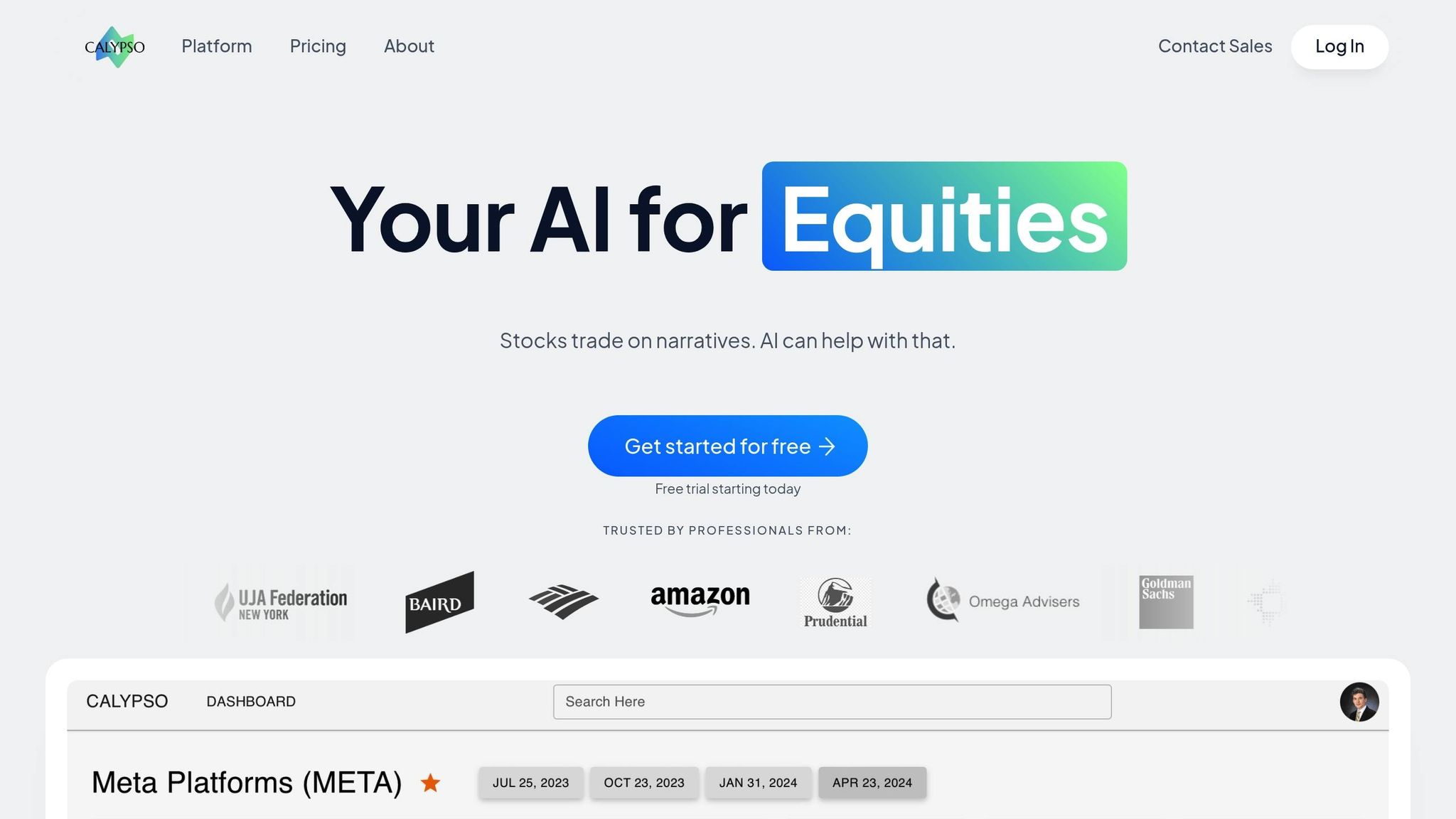
Calypso is an AI-first platform designed to focus on why stocks move by analyzing investment narratives, debates, and thesis tracking - going beyond just the raw numbers.
At the heart of Calypso’s capabilities are several AI-powered tools aimed at tackling common research challenges. These include AI Opinions, which automatically extract key debates; AI Chats, leveraging a GPT-4 class model to reduce call times by up to an hour; AI Profiles, which speed up analyst onboarding by 90%; and Transcript Search, enabling seamless semantic queries across public transcripts.
"Stocks trade on narratives. AI can help with that." – Calypso
Calypso also stands out with its pricing structure. The Basic plan, priced at $10 per month, offers access to financial data, news, debates, and up to 20 AI Opinions and 20 AI Chats daily. The Professional plan, at $399 per month (approximately $4,788 annually), significantly expands this to 400 AI Opinions and 400 AI Chats per day, along with live support. Both plans include instant self-service onboarding and a 14-day free trial. Positioned at about one-fifth the cost of a Bloomberg Terminal, Calypso appeals to individual analysts and smaller funds by eliminating the steep annual commitments typical of traditional platforms.
The platform shines during high-pressure periods like earnings season, particularly for analysts juggling multiple companies. Features like Automated Earnings Previews ensure no critical event slips through the cracks, while the Thesis Tracking journal helps users avoid "thesis creep" by comparing expected outcomes with actual results.
"After experiences in AI research and public equities, we realized public market investors were deeply underserved." – Calypso Story
In 2026, Calypso serves as a specialized AI analyst, focusing on qualitative synthesis and document intelligence. By prioritizing insights over raw data, it complements traditional tools and meets the evolving demands of equity researchers.
Pros and Cons
Bloomberg Terminal stands out for its precision in quantitative data and professional networking, while Calypso shines in its ability to distill qualitative insights.
Bloomberg's primary advantage is its unparalleled accuracy in quantitative data. With over 30 years of historical financials and real-time market data, it has earned its reputation as the industry's "source of truth", thanks to rigorous quality controls. Another standout feature is its verified messaging system, which facilitates networking across major institutions. As Lincoln Olson points out, "Since most major institutions use Bloomberg Chat, it's the one feature that can't be replicated elsewhere". However, this level of capability comes at a steep cost - approximately $32,000 per user annually. Additionally, Bloomberg's command-based interface can be challenging, requiring specialized training to use effectively.
On the other hand, Calypso takes a different approach, focusing on AI-driven qualitative analysis. Built on GPT-4 class models tailored for finance, it excels at extracting insights from earnings calls and automating processes like journaling to prevent "thesis creep". Its pricing is far more accessible, with plans ranging from basic to professional tiers. The platform's natural language interface is user-friendly, requiring little to no training, and features like AI Opinions significantly reduce research time.
Bloomberg's weakness lies in its retrofitted AI capabilities. BloombergGPT was integrated into an existing terminal-based design, which limits its ability to offer seamless workflow automation. As Marvin Labs notes, "Bloomberg's power lies in the terminal interface, but modern analysts want workflow automation that runs continuously". In contrast, Calypso's limitation is its narrower focus. It doesn't aim to replace Bloomberg's extensive market data infrastructure or fixed-income analytics but instead specializes in document intelligence and narrative extraction.
| Feature | Bloomberg Terminal | Calypso |
|---|---|---|
| Annual Pricing | ~$32,000 per user | $120–$4,788 (Basic to Professional) |
| Data Accuracy | Industry standard for quantitative data | High for qualitative document analysis |
| AI Capabilities | Retrofitted LLM (BloombergGPT) | Native GPT-4 class models for finance |
| Workflow Integration | Manual, command-based | Automated, natural language interface |
| Primary Strength | Networking (Chat) & market data | Quick insights & thesis management |
| Learning Curve | Steep; requires specialized training | Minimal; intuitive interface |
These differences highlight the strengths and weaknesses of each platform, helping users determine which tool aligns best with their specific needs.
Conclusion
Bloomberg is the go-to solution for real-time pricing and trade execution, while Calypso shines in delivering qualitative equity insights. Bloomberg remains the preferred choice for institutional traders and portfolio managers who need global, real-time pricing, extensive cross-asset coverage, and instant trade execution. With an annual price tag of around $32,000 per user, it’s tailored for environments that demand comprehensive multi-asset data and integrated communication tools.
On the other hand, Calypso is designed for fundamental analysts and individual investors who prioritize equity research, hypothesis testing, and extracting insights from earnings calls and filings. Starting at just $10 per month, it offers institutional-grade AI automation without the complexity of a traditional terminal. Built on GPT-4-class models trained specifically in finance, it provides a streamlined, focused experience for qualitative analysis.
This comparison highlights a broader industry shift toward modular, AI-powered research tools. By 2026, smaller firms and individual investors are increasingly adopting these tools, combining API-native data providers with specialized AI-driven platforms to achieve institutional-level efficiency at a fraction of the cost. Bloomberg’s strength lies in its execution and real-time data capabilities, while Calypso excels in narrative tracking and preventing "thesis creep" through features like automated journaling and debate extraction.
Ultimately, Bloomberg is best suited for workflows centered on trading and execution, while Calypso’s AI-first design is ideal for fundamental analysis and insight generation. Together, these tools illustrate how blending traditional quantitative platforms with modern AI-driven solutions is shaping the future of investment workflows.
FAQs
How does Calypso boost productivity in equity research?
Calypso boosts productivity in equity research by leveraging AI-driven automation to tackle tedious tasks. It processes vast amounts of financial data, extracts critical metrics, and generates real-time market alerts. This frees up analysts to concentrate on in-depth analysis rather than spending time on manual data collection.
The platform also sharpens decision-making with predictive modeling and pattern recognition, making it easier to pinpoint investment opportunities and assess risks more effectively. Its user-friendly tools simplify collaboration, allowing teams to share insights effortlessly and maintain smooth workflows. By streamlining these activities, Calypso enables analysts to deliver quicker, more detailed, and accurate investment insights in today’s high-speed markets.
How do the AI features of Bloomberg Terminal compare to those of Calypso?
Bloomberg Terminal and Calypso each use AI in distinct ways, tailored to their specific purposes and user needs.
Bloomberg Terminal applies AI to process massive volumes of unstructured data - think financial documents, news articles, and research reports. Its tools excel in advanced document searches, summarizing content, and delivering real-time insights. This functionality helps users make quicker, data-informed decisions while staying compliant with regulations. It’s a go-to solution for those diving deep into market analysis and research.
Calypso, however, leans more toward automation, predictive analytics, and operational efficiency. Its AI features are built to simplify workflows, improve risk management, and fine-tune daily financial operations. While Bloomberg emphasizes synthesizing data and generating insights, Calypso focuses on boosting the efficiency and accuracy of financial systems.
Why would a smaller firm consider using Calypso instead of the Bloomberg Terminal?
Smaller firms might lean toward Calypso instead of the Bloomberg Terminal because it’s easier on the budget and simpler to navigate. While the Bloomberg Terminal is undeniably powerful, packed with real-time data and advanced analytics, its hefty price tag - ranging from $25,000 to $32,000 annually - can be a major barrier for businesses with tighter budgets.
Calypso, on the other hand, delivers a cost-effective alternative without skimping on the essentials. It provides access to financial data and AI-driven insights, all wrapped in a modern, intuitive interface. This eliminates the steep learning curve that often comes with using the Bloomberg Terminal, making it a better fit for smaller teams or firms with limited resources. With Calypso, businesses can handle equity research and analysis efficiently, equipping them with the tools they need to make smart financial decisions without breaking the bank.
